
Why I Haven’t Left
A reflection on Mike X Cohen’s “Why I Left Academia and Neuroscience”

Mike X Cohen recently wrote about why he left academia and neuroscience. His essay resonated with many of us who have spent our lives in this strange ecosystem of metrics and meaning. He described the sense that everything had begun to repeat itself: the same studies, the same conversations, the same incentives to produce more of what already exists. I understand that fatigue completely.
When Mike writes about how he loved research as a graduate student, the long hours, the sense of discovery, the feeling of being inside a mystery, I recognize myself in that too. I loved it.
The work felt purer then. The questions were real. There was still the thrill of finding something that no one else had seen.
The truth is, I still chase that feeling. But it’s harder now. Research has become a carousel of incremental questions. Even inspiration has been domesticated by productivity. And for many, that cycle leads to exhaustion. Academia can nurture the mind but deplete the spirit. Burnout has become not the exception but the cost of survival.
A colleague once left academia for industry. In four years, he earned more money than he will make in the rest of his career. But no matter how supportive his boss was or how ideal the job seemed, there was always a bottom line. Every project had to serve profitability. Research needed to show a return. It had to generate value that could be measured in dollars.
He came back to academia because, for all its flaws, it remained one of the few places where he could still think freely. Here, not every idea had to justify itself in financial terms. Some work could exist simply because it asked a good question.
I never bought into productivity as an end in itself. I entered this field for discovery, for the electric moment when something unknown begins to take shape. That impulse has guided every step of my career, even when it carried me away from convention. I never believed that the value of our work could be captured in citations or h-indices. What matters is whether an idea reveals something real, something that changes how we see.
The irony is that in an age of limitless information, genuine discovery has become rare. We are surrounded by data and yet starved for insight. Knowledge expands, understanding thins. The task now is not to gather more facts, but to cut through the noise, to recover the place where curiosity melds into clarity.
And that is where AI enters the story.
Paradoxically, AI may be what finally ends academia’s obsession with volume. When machines can generate limitless text, quantity loses its meaning. What remains is quality of thought, the slow and deliberate work of interpretation and synthesis. AI does not threaten meaning; it exposes how little of it there was.
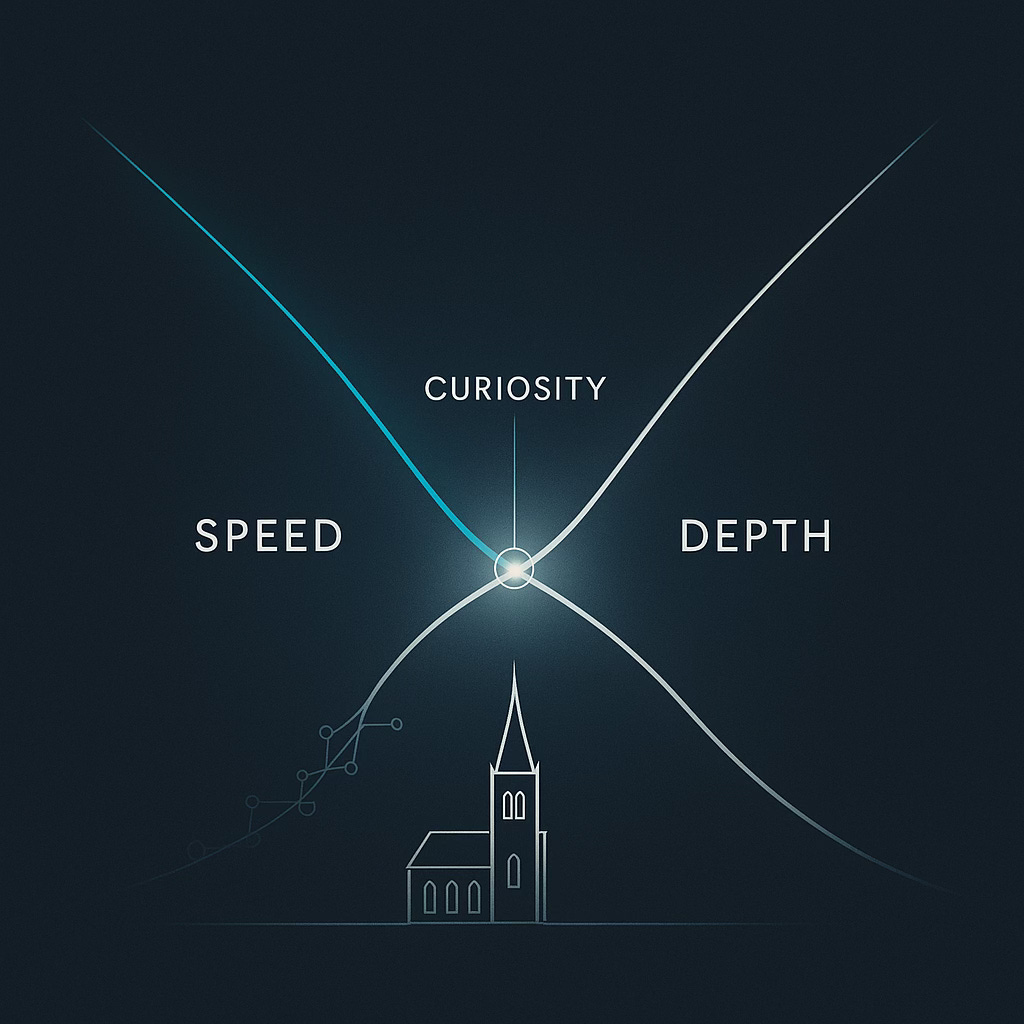
For me, that realization has been liberating. It has allowed me to move differently, to think at various tempos at once. AI can accelerate what must move quickly, but it has also opened the space to slow things down. It has helped me wade into areas that were unreachable just a few years ago. It lets us linger with ideas again, to follow intuition into deeper and deeper waters without the fear of drowning.
Discovery now happens across many spaces: in the lab, yes, but also in writing, on Substack, in Psychology Today, and in books that allow thought to unfold at its own pace. These forms let me explore concepts in ways that scholarship alone cannot. They bridge the personal and the intellectual, the public and the private, the fast and the slow.
I know that staying is, in some ways, a privilege. But it’s also a choice to stay true to the part of my work that first drew me in.
Academia may have lost some of its vitality, but that only makes the work of renewal more urgent. We can leave it, as Mike did. Or we can stay and remake it, not as an engine of productivity but as a space for discovery.
Machines can process information at light speed.
It is up to us to slow down, to find meaning in it.
That is why I haven’t left.
Excellent and eloquent post, Arturo.
Your post and Mike’s should be assigned in tandem to grad students ❤️
I would love a post about how you use AI to slow down. Your previous post on how it helps you in your writing process resonated with how I use it.