
The Language We Carry Back

As we stood there, I wondered what life must have been like for my great-grandfather, Wilhelm Heinrich Stevens Sarto, in the late 1800s. More than 100 years later in 2009, the world would have been largely unrecognizable to him. Modern technology had swept across the world’s landscape, reframing almost every corner of our globe and every second of human life. What had taken my great-grandfather months to accomplish had happened in less than a day. What would have been a luxury, a trip lasting months in transit, was thanks to airplanes no longer a luxury.
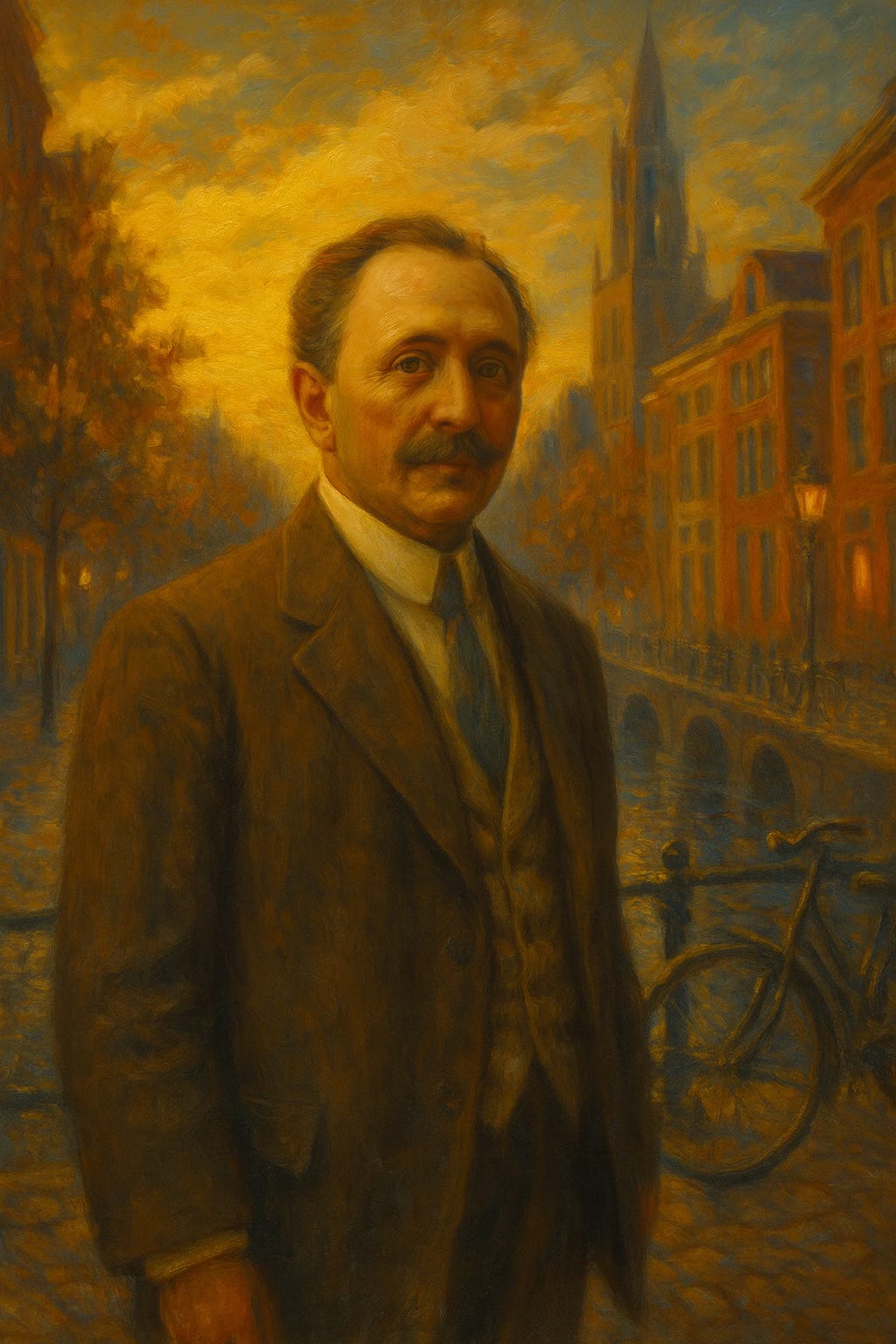
Artwork generated by ChatGPT (OpenAI) using a family photograph supplied by the author.
Wilhelm grew up in Utrecht, already a border child—Dutch by upbringing with a mother of Italian descent, Johana Sarto, who had moved from Scotland. The story was that Wilhelm’s mother was related to Pope Pius X, Giuseppe Melchiorre Sarto. At least that is the story my dad told me. When Wilhelm left for San Luis Potosí, Mexico, he had already adapted to living between worlds. It was the prelude for the journey that would define his life.
He had gone to Mexico searching for his brother, who had traveled there years before and disappeared, leaving no trace or word of where he had ended up. Wilhelm looked where he could but the trail ran cold. He never found him. But in searching, he found something else: San Luis Potosí, Guadalupe Moreno, a life he could never have imagined. There he had five children. He adapted to life in central Mexico. He learned Spanish, built a home in a colonial city in the high desert far from the netherlands of his youth. But in adapting, he changed his immediate world too. His household became something neither fully German nor fully Mexican: a hybrid space where children grew up speaking Spanish, attended English-speaking schools, and celebrated traditions that carried traces of both worlds.
Wilhelm never taught his children German. The language was gone within a generation. Nevertheless, certain things persisted, many transformed. At Christmas, the Stevens Moreno made bolitas de navidad—round, fried, dusted with sugar, a tradition that had always seemed to be entirely Mexican. I didn’t know until decades later, standing in a German bakery, that the bolitas were pfannkuchen, berliners, gezuckert, carried across an ocean and converted into something new. Neither German nor Mexican. Both.
The eldest of Wilhelm’s children, my great-aunt Wilhelmina—my tía Minita—grew up with Germany as a distant dream, a shimmering oasis she would talk about every day but visited only twice. She had gone once, as a baby. My dad would point to his grandparents’ picture in the dining room of his aunts’ home. It was a photograph of Minita as a baby with her parents in Germany, a portrait of belonging divided between two worlds. Her cousin Wilhelm had taken his aunt Wilhelmina, known as Helma, to San Luis Potosí. Helma and Minita had met, two cousins with identical names separated by an ocean and a good chunk of the 20th century.
By the time Wilhelm’s adaptation reached me, I was the product of that cascade. My border had run between Mexico and the Northern California, making me a simultaneous bilingual from birth, Spanish and English woven together, and eventually a neuroscientist studying the very bilingual brains his migration had created. His choices had rippled forward, shaping not just who we were but what we would study, how we would think.
Now, generations later, we were making the same trip in reverse.
The morning of my talk at the International Symposium on Bilingualism in Utrecht, I walked through the old city center before heading to the conference. Wilhelm Heinrich had walked these streets more than a century before, a young man navigating between worlds, already a border child before he crossed an ocean. The streets hadn’t changed much. The brick buildings still stood, their facades weathered by time but intact. But everything else had been rewritten.
I tried to imagine what it must have been like for him. What thoughts went through his mind as he prepared to leave? Did he stand on these same streets, wondering if he would ever return? Did he know, even then, that he was carrying something across that would outlast him?
That afternoon, I stood in a multilingual university hall, surrounded by colleagues from the United States, Spain, Germany and many other countries. I gave a talk on the bilingual brain, on neural plasticity, language-switching, the prefrontal cortex. The technical language of my field. But as I spoke, something else was happening. I was presenting research on the very phenomenon Wilhelm’s journey had set in motion. His adaptation had become my subject. His crossing had made my work possible. The personal and the scientific had collapsed into the same story.
Standing there in his city, speaking about brains shaped by multiple languages, I felt the recursion click into place. This is what translation does. It doesn’t just move words from one language to another. It moves lives, shapes minds, creates futures that would have been otherwise impossible.
After the conference, we boarded a train and rode east to a small town outside of Düsseldorf, where my father’s second cousin lived. We spent the next few days with my Uncle Willy and his wife. They spoke little English and no Spanish; Kiara and Nikolas, managed just fine. Trilingual children moving effortlessly between all three languages. They carried Wilhelm’s German, our Mexican Spanish, and their Californian English simultaneously, as naturally as breathing.
I watched them, marveling. I had also ventured into trilingualism learning Portuguese at twenty, and now, later in life, was struggling with German, my fourth language. My thoughts came in floods; my words, dripped out like droplets out of a clogged faucet. But my children had something different. They had recovered what Wilhelm’s children had lost.
One afternoon, Uncle Willy brought out an old album they had made for Der Wanderer—a photo album they had made for Wilhelm Stevens. He opened it carefully, and as he turned the pages, I felt time fold in on itself.
There were photographs of San Luis Potosí. The colonial streets I’d walked as a child. My father’s family gathered in the courtyard. My tías standing in their home with its intimate central patio where the extended family gathered every Christmas Day for dinner. Noche buena, Christmas Eve was always reserved for Los Corpi Constantino, my mother’s family. My father and his cousins had spent each Noche Buena with their own families. Christmas Day was reserved for the larger gathering that would spread across my tias Stevens’s home and the tile factory my great grandfather had left for them to run.
Uncle Willy pointed to faces and spoke about the families in German. I understood everything as my uncle spoke slowly and clearly so that I could keep up. My children adapted effortlessly, always nodding just a step or two before I did. Here, in this small German town, thousands of miles from Mexico, the same faces I had known in my childhood were appearing in a photo album, being remembered in a language my great grandfather had chosen not to pass on.
I thought of my tía Minita. She had grown up with Germany as a distant dream, a place she would talk about every day but visit only twice—once as a baby in that photograph my father always pointed to, once as an adult. She had longed her entire life to return, to see where her father had come from, to stand in the place that haunted her imagination.
She never got to see this moment. Never got to see us meet Uncle Willy, never got to see the album, never got to hear her great-grandniece and great-grandnephew speaking fluent German in her father’s homeland.
But here I was, a descendant of the Stevens who had gone back to her father’s land, Das Land meines Urgroßvaters.And my children were speaking her father’s tongue.
The language hadn’t come back by accident.
In 2002, when Kiara was six and Nikolas three, I received a fellowship from the Max Planck Institute for Cognitive Neuroscience in Leipzig. We spent a year in Germany. The children learned German through immersion—playing with neighborhood kids, attending local schools, absorbing the language as naturally as Wilhelm’s children had absorbed Spanish in San Luis Potosí a century before.
I remember the first time I heard Kiara speak a full sentence in German. We were at a playground, and she was playing with two other girls. The words came so easily, so naturally. I stood there frozen, listening to my six-year-old daughter speak the language her great-great-grandfather had chosen not to pass on.
When we returned to Houston, Kiara and Nikolas enrolled in the Deutschessamstagsschule—Saturday German school—to maintain what they’d learned. Every Saturday morning, while other kids slept in, watched cartoons, or played with their friends, mine went to school to keep a language alive that they had no pragmatic need for. Learning a new language is not always purely pragmatic. In our case, it was something else. It was memory carried forward. It was keeping a door open.
Then came three more summers in Berlin, from 2007 to 2009, supported by a Humboldt Foundation fellowship. By the time we visited Wilhelm’s relatives that summer of 2009, my children had spent seven years moving back and forth between continents, weaving German into their lives the way Wilhelm had woven Spanish into his.
German hadn’t survived in Wilhelm’s household. But three generations later, through repeated returns and deliberate cultivation, it came back, native and fluent in his great-great-grandchildren.
We carried something back across the ocean, and the encounter changed us. The family story that had lived in memory became lived experience, and that changed how we understood who we were.
Translation, from the Latin translatus, means “to carry across.” My great-grandfather carried himself across an ocean. He carried his capacity for adaptation, his willingness to become someone new while remaining himself. I carried his story back, walking the streets he had walked, presenting research on the brains his choices had shaped. My children carry it forward in three languages, adapting to each world they enter with an ease that still astonishes me.
What they’re really carrying is something deeper than language. They’re carrying the knowledge that you can belong to more than one world. That you can move between them without losing yourself. That adaptation isn’t about abandoning who you are—it’s about becoming who you need to be, again and again.
When I think back to that visit in Germany, I remember watching Kiara and Nikolas laughing with their relatives in a language that slowly was feeling less and less foreign to me, a language their great-great-grandfather’s children had lost, now recovered in them. I thought of Wilhelm making his way from Utrecht to Mexico with nothing but faith in the possibility of connection, searching for a brother he would never find but discovering a life he could never have imagined.
And I realized that across all those generations, something essential had remained. Not the language. Not the specific traditions. Not even the names, though we kept recycling those, two Wilhelminas, two Wilhelms, the names themselves a sign of parallel lives across two continents.
What remained was the capacity itself. The ability to adapt, to reach across boundaries, to translate ourselves into new worlds while maintaining some essential continuity of self.
Perhaps that is the real inheritance. Not what we carry, but that we can carry at all. Not the specific languages or traditions or memories, but the ability to move between them, to become bilingual, trilingual, to stand in our great-grandfather’s city in a recursive journey.
We are translation made flesh. We are adaptation made conscious. And every time we cross a border, between languages, between countries, between who we were and who we’re becoming, we honor everyone who came before us and made the same crossing, carrying something precious across time, across space. Technology advances in leaps and bounds, accelerating the transmission of information. But human connection, our ability to translate, that does not change.
For a more technical exploration of how bilingual brains reveal fundamental principles of human adaptation, see my companion piece in Psychology Today: “Translation as Adaptation: What Neuroscience Reveals About Human Intelligence.”