
The Lab That Sees Itself
On Wrike, collaborative flow, and the future of work

It’s been a while since I reflected on how tools once feared for flattening human inquiry might now help restore it. I want to bring that question down to earth—into my lab, where rehumanization doesn’t start with theory. It starts with structure.
When I was a kid, I used to imagine what it would be like to carry a communicator like Captain Kirk. Now we all carry one—in our pockets, always on, always listening. Somewhere between the wonder and the overload, we forgot we were in charge. The dream of collective connection became something else—sometimes awe-inspiring, sometimes unnerving. It reminded me of another kind of network: the Borg, a hive mind built on assimilation. At first, this digital collective seemed full of promise—seamless connection, instant access. But over time, it shifted. Instead of helping me, it began to feel like a swarm of digital piranhas—every notification, every message, nibbling at my attention, slowly eroding my sense of self.
Most labs still run on email. Attachments, follow-ups, reply-all chains. Others use Slack—endless threads spreading in a million directions, fragmenting the flow rather than harmonizing it. Productivity has become synonymous with chaos. When something gets done, it’s often despite the system—not because of it.
I wanted something else. Something quieter. Smarter. More like the brain—more like a conversation.
So we started using Wrike, a collaborative project management app.
Many people wondered what I was doing. At first, it was just a digital clipboard. But soon, our shared attention began to organize itself. Wrike became our externalized memory, reflecting our thoughts back to us like light shifting across the surface of a pond—responsive, alive, always changing with what we bring to it.
Every Wednesday, our lab agenda generates itself. Not from scratch, but from a system of linked tasks, deadlines, and shared goals. Everyone sees what’s moving. Everyone knows who’s involved. No one has to dig through inboxes or scroll through lost documents.
We have a booth to repair? That’s a task.
A student needs help preparing a bilingual language assessment? It’s already there.
Data from a neuroimaging session needs review? Assigned, scheduled, described.
It’s not just about being efficient. It’s about being present.
When the structure is visible, you can breathe inside it—and it can breathe inside of you. You don’t have to carry the entire system in your head. It’s there when you need it—and it goes away when you don’t. You’re free to think, to create, to contribute.
People didn’t quite understand. So I visualized it—fed our tasks into ChatGPT—and the result was astonishing: the lab looked like an eye. That felt right. The lab isn’t a machine—it’s part of a nervous system. Each person, each task, tied together as part of a larger whole. The shape wasn’t hierarchical. It was relational—sensory, motor, and visual, like a system tuned not just to act, but to see.
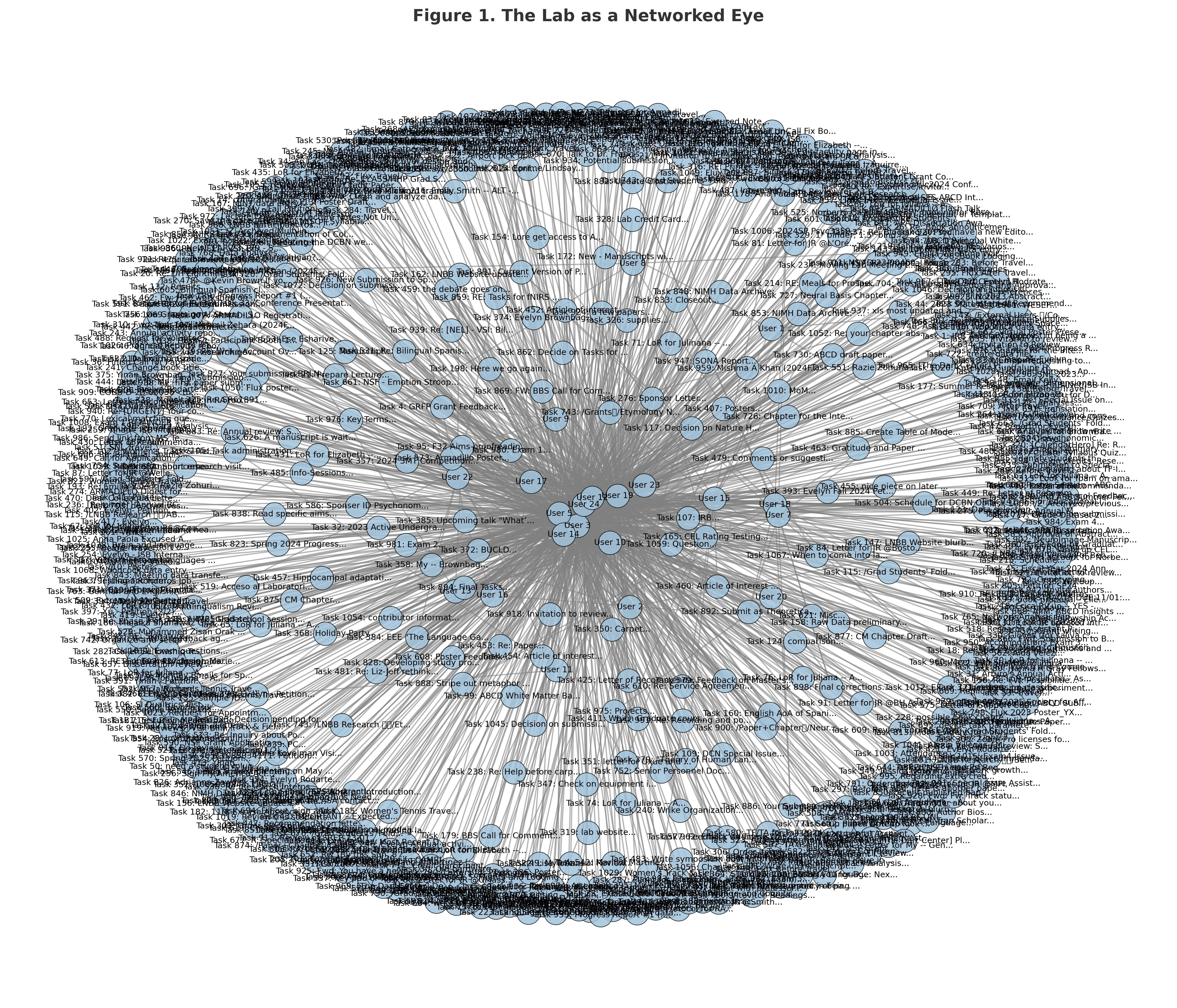
Figure 1. The Lab as a Networked Eye
A data-driven visualization of how tasks and collaborators in our lab self-organize into a cognitive web—not unlike the neural structure of the brain itself.
This, I think, is the future—not just of labs, but of work itself.
Not digital in the cold, mechanical sense, but relational. Interactive. Natural. Not untouched, but responsive. Like an organism adapting to its ecosystem. Like neurons firing in concert. Technology that adapts—not automates.
We didn’t set out to build a new kind of lab. We just started listing everything—every task, every goal, every next step. And in that listing, something shifted. We started to notice the patterns. It wasn’t static. It was signal—flickers of light across a surface, glimpses of order emerging from motion. And slowly, the lab began to think with us—and us with it. We had found another way to move through the swarm.
Maybe resistance isn’t futile after all. Maybe the collective doesn’t have to assimilate us—but can augment us.
To see along with the hive.
To think together, without losing sight of ourselves.
If you enjoyed this, subscribe for more reflections on cognition, technology, and the evolving mind.