
The Interference Tax
It’s not that students learn worse. It’s that everything interferes with everything else now.

When I went to college, I took a few things with me: some notebooks, my textbooks, a lamp. I didn’t even have a stereo. The small one with the cassette player belonged to my roommate. My days were predictable. Up in the morning, dorm food, eight o’clock class, biology or math, then food again if I’d missed breakfast. The rest of the day interleaved between physical activity and class, between things out in the world and things in the classroom. At night I studied for about three hours. Never more.
The interleaving was physical and social. It was not cognitive, or not very. Walking somewhere. Talking to someone. Eating with people. Waiting in a line. That was the texture of life between the things you were trying to learn.
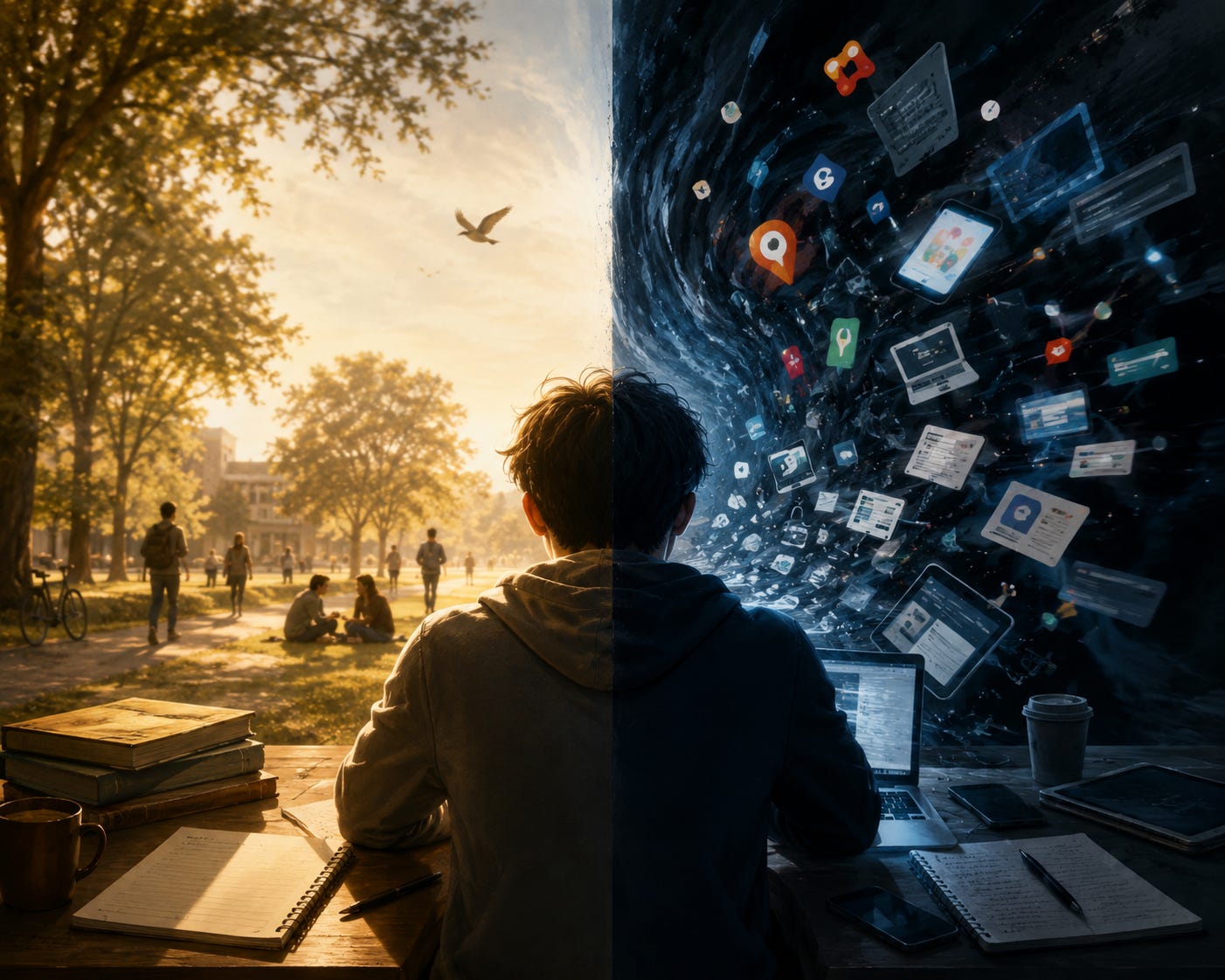
Today the equation is different. Wake up and the cognitive work begins before the cognitive work of school or the job. Open the navigation panel in the car: each turn an instruction to process. Book a flight on the United app: pick the day, pick the time, weigh the layover, click through the seat map. Buy a ticket, scan a QR code, onboard a new app, update a password. None of this feels like learning. All of it is small symbol manipulation, schema acquisition, procedural memory. The interleaving used to be social and physical. Now it’s cognitive.
This matters because of how memory actually works. Müller and Pilzecker showed in 1900 that even brief mental activity right after learning degrades retention. They called it perseveration: the idea that a memory trace needs quiet time to stabilize, and that the cognitive activity right after encoding determines whether it survives. We call the failure mode interference. What came before gets in the way of what comes next, and what comes next gets in the way of what came before. The classroom sits between both, all day. A generation ago, much of the cognitive day paused when the bell rang. The interpolated material was a walk home, chores, unstructured play, dinner without screens. Those weren’t empty. They were consolidation windows, when the brain stabilized what got encoded in third period. Modern researchers call these windows “wakeful rest,” and a century of interference work has shown the same effect from the opposite direction: the more the interpolated activity resembles what you just learned, the more it costs you.
That second finding is the structural problem. Apps teach procedures. Math teaches procedures. Social media teaches social categorization. History teaches social categorization. The new cognitive demands of daily life are not noise around school content. They are formally similar to it. That is the worst kind of interference there is.
I feel it myself. I know more than I used to, and I cannot learn as quickly as I used to. Part of it is age. Part of it is that what I do at a computer for work and what I do at a computer for life interfere with each other in ways they never used to.
We aren’t the problem. The noise we built around the signal is.