
The Immovable System
What Peppered Moths Tell Us About Tariffs

In the mid-nineteenth century, something remarkable happened in the forests around Manchester. The peppered moth, whose light-speckled wings had evolved over millennia to blend into lichen-covered bark, began to disappear. Not the moth itself — its darker variant, previously rare to the point of biological insignificance, started taking over. By 1895, nearly 98% of Manchester’s peppered moth population was the dark carbonaria form. Industrial soot had blackened the trees, and the system adapted with ruthless efficiency.
This is the story evolutionary biologists tell as the clearest observable example of natural selection in action. But I want to tell a different version of it — one about the limits of power, the physics of complex systems, and why the Supreme Court’s ruling today on Trump’s tariffs was probably inevitable from the moment the tariffs were imposed.
Bear with me.
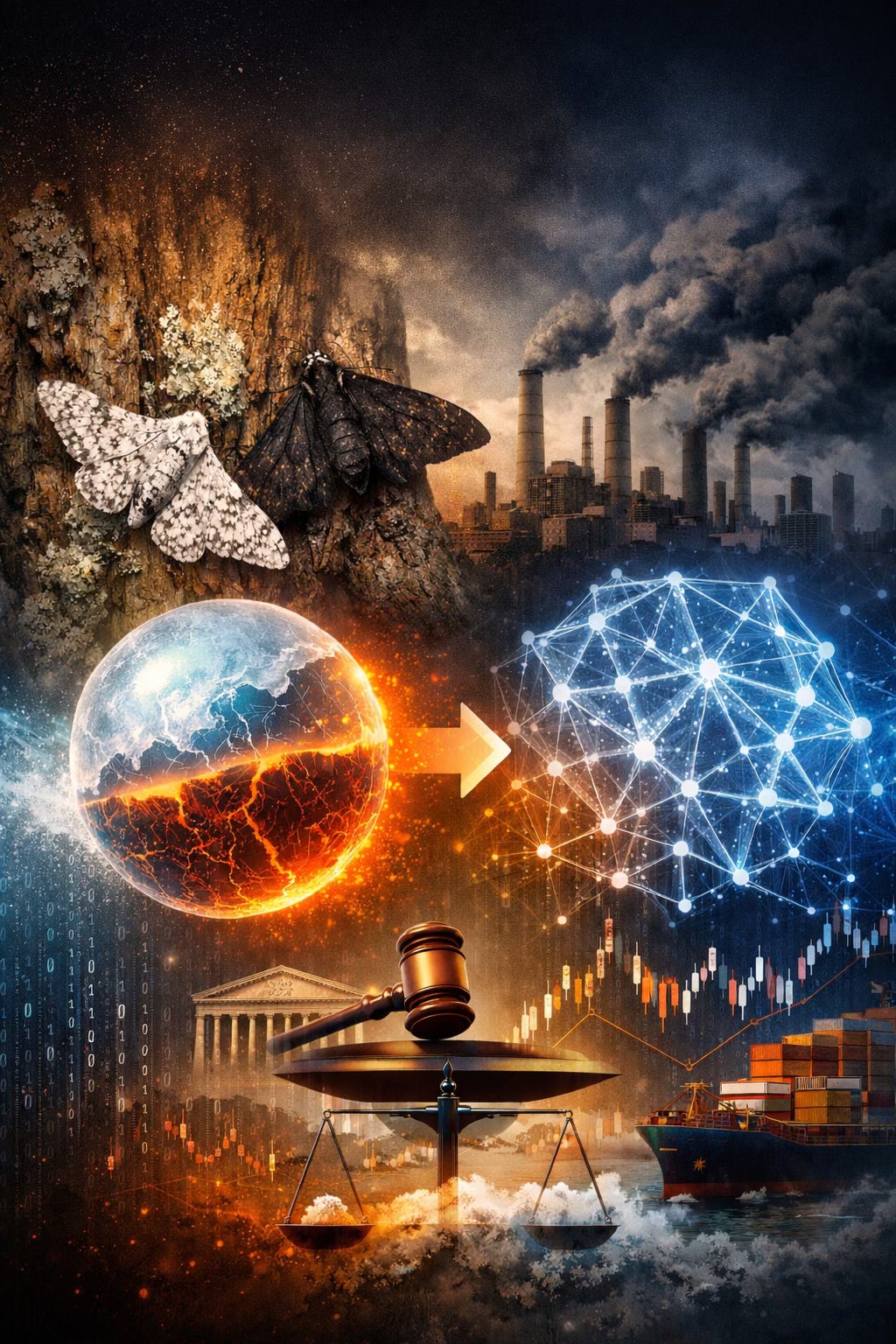
The peppered moth story is usually told as a story about change. Pollution comes in, the population shifts, the environment wins. But the deeper story is about homeostasis — the system’s relentless drive back toward equilibrium. When clean air legislation reduced industrial pollution in the mid-twentieth century, the light moths returned. The system didn’t collapse. It didn’t permanently transform. It reset. What looked like a dramatic revolution in moth phenotype was actually the system oscillating around a stable attractor, perturbed temporarily by an external forcing function.
Teilhard de Chardin saw something like this operating at a much larger scale. His concept of the noosphere — the layer of human thought and culture wrapped around the planet like a living membrane — wasn’t merely poetic. It was a claim that human information systems are subject to the same emergent dynamics as biological and molecular systems. That culture, institutions, markets, and law behave like complex adaptive systems with their own homeostatic logic.
I’ve been developing a framework I call computational emergentism to formalize this intuition. The core claim is simple: complex systems — whether molecular, biological, or informational — generate emergent properties that cannot be predicted or controlled by manipulating individual components. The whole acquires dynamics that transcend its parts. And crucially, these systems resist perturbation. They absorb forcing functions. They adapt.
Now consider what happened beginning in April 2025, when the most sweeping tariff regime since the 1930s was imposed on nearly every American trading partner. The stated goal was systemic transformation — to fundamentally restructure global trade, reshore manufacturing, extract concessions, generate revenue, and reassert American economic dominance simultaneously. It was, by any measure, an extraordinary forcing function applied to an extraordinarily complex system.
And the system pushed back. Immediately, continuously, from every direction at once.
Markets adjusted. Companies filed preemptive refund claims before any court had ruled. Foreign trade partners reshuffled relationships, signing new agreements that deliberately excluded the United States. China recorded a $1.2 trillion global trade surplus — the highest ever recorded by any country — as Chinese firms rerouted exports to other markets. The EU accelerated deals with Mercosur and India. Legal challenges came from a dozen states and hundreds of businesses simultaneously. And this morning, the Supreme Court ruled 6-3 that the emergency powers invoked to impose the tariffs exceeded presidential authority.
From perturbation to reset: roughly fourteen months.
Compare that to the peppered moth. Manchester’s forests absorbed industrial pollution for decades before the phenotype shifted. The recovery after clean air legislation took another thirty years. The system’s feedback loops operated on biological and legislative timescales — years, decades, generations.
What compressed fourteen months of systemic resistance into what previously would have required decades? The answer is the informational singularity — the exponential densification of our information environment that has fundamentally altered the computational properties of social systems.
Water doesn’t gradually become ice. It reaches a threshold and its entire molecular structure reorganizes instantaneously. The new state has completely different properties — the same molecules, the same mass, but a fundamentally different relationship between its components. This is what physicists mean by a phase transition, and I think it describes precisely what has happened to social systems in the age of information abundance.
Pre-singularity social systems behaved like water — fluid, reorganizable, susceptible to forcing functions. Industrial pollution could reshape an ecosystem over decades. A sufficiently powerful economic policy could restructure global trade over years. The medium was plastic enough to hold a new shape when pressure was applied consistently and long enough.
But information density has driven social systems across a phase transition. Not toward ice — pure rigidity — but toward something more interesting and more strange. The surface remains turbulent, fluid, reactive. Beneath it the structure has become crystalline — each node coupled to every other node, each perturbation immediately distributed across the entire system, generating simultaneous resistance from every direction at once.
The tariffs hit this surface and produced enormous turbulence. Markets moved. Headlines multiplied. Reactions cascaded globally within hours. But the underlying structure — legal, institutional, financial, informational — behaved like ice. It didn’t reorganize. It reflected the energy back.
And here is the physical fact that makes this more than metaphor: you cannot un-boil water by applying the same heat that boiled it. Once a system crosses an informational phase transition, the old forcing functions stop working. More pressure doesn’t produce more change. It produces more heat, more surface turbulence, faster dissipation — and faster return to equilibrium.
The humbling implication of this framework is that it favors no political position. It says that grand ambitions across the entire spectrum — revolutionary or reactionary, left or right — face the same computational headwind. Surface turbulence has become cheap and structural change expensive. The informational singularity has made the system simultaneously more dynamic in its visible behavior and more resistant to deep reorganization.
The peppered moths of Manchester eventually returned to their light-bodied equilibrium. Not by design, not by command, but because complex adaptive systems always find their way back.
Today’s ruling removed a forcing function. The system is finding its way back.
Whether that’s reassuring or alarming probably depends on which changes you were hoping the perturbation would produce. But as a description of how systems actually behave — from forest ecosystems to global trade networks — it has the uncomfortable ring of truth.
This is a very interesting perspective Arturo. I think about similar things and often have a hard time identifying what the system vs components are. I guess that’s a fundamental challenge for any framework that tries to explain multiple scales (for example, is the US here the system or a component of the world system, or can we apply the theory to each problem separately). Anyway, great stuff. Cheers