
The Fourth Register
When Intelligence Requires a Partner

I learned German at thirty-five. Not as a child absorbing grammar through play, not as a young adult with neural plasticity still running hot, but as a mid-career neuroscientist with a family, a research program, and the kind of cognitive rigidity that comes from decades of thinking primarily in two languages.
The occasion was a fellowship at the Max Planck Institute for Cognitive Neuroscience in Leipzig. Angela Friederici had invited me to spend time in her lab, and I arrived in 2002 speaking no German whatsoever. My children learned through immersion, playing with neighborhood kids, attending local schools, absorbing the language with the ease only children possess.
I learned differently. Slowly. With effort. Through formal instruction and awkward conversation and the particular humiliation of watching your six-year-old daughter speak fluently in a language where you can barely order coffee.
Twenty-three years later, my German remains functional but limited, adequate for daily life but insufficient for intellectual work at the level I’m accustomed to.
Or so I thought.
The Letter
Last year, colleagues in Germany were preparing a Festschrift to honor Angela Friederici’s retirement. Would I contribute a short piece reflecting on what her invitation twenty-five years ago had meant?
I wanted to write it in German. The language choice mattered symbolically. Angela had opened a door to Germany for me, one that led to research opportunities and to a genealogical return I’ve written about elsewhere. Writing to her in German would complete a circle.
I couldn’t write it at the register appropriate for honoring one of the most important neuroscientists of our generation.
So I did something I’d been experimenting with for other kinds of writing: I used AI.
Here’s what I actually wrote, dictated in my basic German:
Liebe Angela, vor 25 Jahre habe ich eine Einladung von dich bekommen. Ich habe nach Deutschland anreisen und spreche kein Deutsch. An der MPG in Leipzig habe ich mehr als Forschung gelernt. Mein Urgroßvater kommt aus der Grenze zwischen Deutschland und Niederlande. Seine Tochter, meine Großtante Wilhelmina war halb Mexikaner aber halt immer über ihre deutsche Familie gesprochen. Du hast diese Tür nach Deutschland geöffnet.
It’s comprehensible. The semantic intentions are there. But it’s grammatically imperfect, stylistically flat, and completely inadequate for the formality required.
I fed this to Claude, asked it to render my thoughts in proper literary German, and received back something entirely different in polish but identical in meaning. The final version began:
als ich vor fünfundzwanzig Jahren eine Einladung von dir erhielt, ahnte ich nicht, wie sehr dieses Schreiben mein Leben verändern würde. Ich kam damals nach Deutschland, ohne ein Wort Deutsch zu sprechen...
Same memories. Same gratitude. Same genealogical thread connecting Wilhelm’s departure from Utrecht to my children’s recovery of German in Leipzig. But now rendered at a register I couldn’t achieve alone.
The AI hadn’t written my letter. I had written it. The AI had translated me from my German into proper German.
Not Translation, Extension
This is different from what happens when I use AI with my other languages. In English, it sometimes introduces rhetorical tics that aren’t quite mine. In Spanish, it changes almost nothing, my narrative voice emerges already integrated.
With German, AI functions as something else entirely: a linguistic prosthesis.
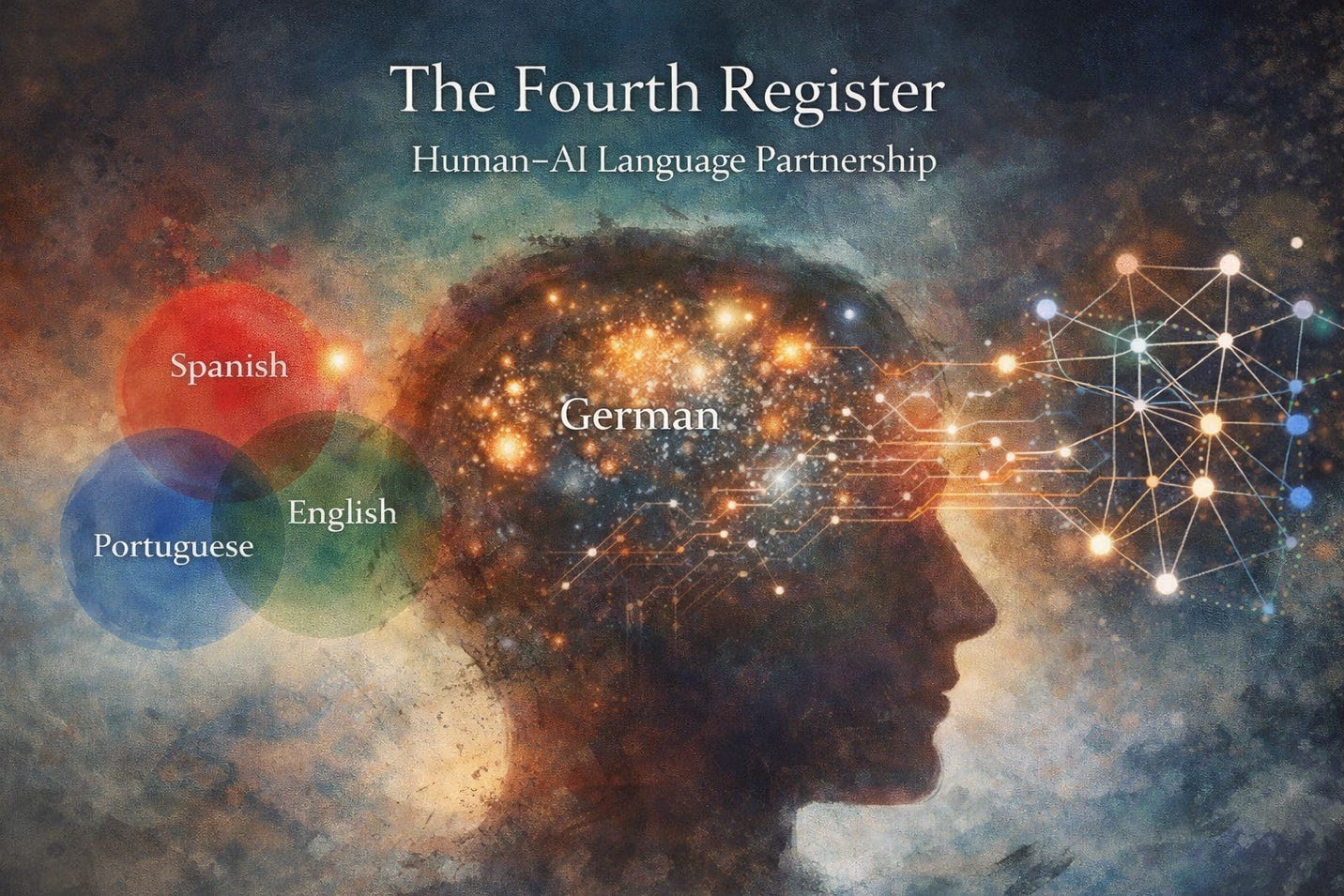
I can think in German at a basic level. I know what I want to say. I have semantic intentions, emotional resonances, specific memories I want to invoke. What I lack is syntactic scaffolding to express those intentions at the required register.
AI provides that scaffolding without replacing my intentions. It extends my expressive range while preserving what I actually meant to communicate.
This isn’t conventional translation, taking content from one language and rendering it in another. This is register translation within a single language. Taking what I can express in basic German and rendering it in literary German, while keeping the semantic core intact.
From a neuroscientific perspective, German activates the same prefrontal-temporal networks as my other languages, but with far less automaticity. The circuits exist; they’re just not efficient. I have to consciously construct what flows naturally in English or Spanish.
AI acts like an external loop in those circuits. I generate the semantic framework, the what I want to say. AI provides the syntactic architecture, the how to say it at scholarly register. The result is collaborative production neither of us could achieve alone.
My German remains basic. But my accessible German, mediated through AI, reaches scholarly competence.
The Implications
Everyone worries that AI will replace human language production. But my experience suggests something different: AI can expand the linguistic range available to human consciousness.
I think in four languages but can only write fluently, at scholarly level, in three. German is the fourth, present, active, capable of generating meaning, but not capable of the formal precision required for academic participation. AI gives me access to that precision, which means I can now participate in German intellectual life in ways that would otherwise be linguistically foreclosed.
This matters because language choice signals symbolic belonging.
When I wrote to Angela in German, I wasn’t just conveying information (English would have done that fine). I was performing a return. I was saying: I belong to this world. This language is mine too, even if I need help to speak it properly.
Without AI, I couldn’t have made that gesture. The AI assistance didn’t undermine it, the assistance enabled it.
This reframes multilingual competence itself. The traditional model is binary: you’re either fluent or you’re not. But AI collaboration suggests distributed multilingualism, where linguistic competence exists across human and artificial intelligence working together.
My children recovered German through immersion, years in Berlin, German schools, the fluency that comes from living inside a language. I’m recovering German through AI partnership, maintaining basic proficiency but extending it through technological scaffolding to achieve scholarly participation.
Both are valid forms of linguistic repatriation. The difference is mechanism, not legitimacy.
Translation as Cognitive Extension
In “Translation as Adaptation,” I argued that human intelligence is fundamentally about moving between incompatible systems, between computation and embodiment, between what we can articulate and what we intuitively understand.
AI-mediated language extends this framework. If adaptation requires translation, and AI can translate between proficiency levels within a language while preserving authorial intent, then human-AI collaboration becomes a new mode of adaptive intelligence.
This is genuine partnership: humans provide semantic intention, lived experience, embodied meaning. AI provides formal precision, structural scaffolding, register-appropriate expression.
Conclusion
In “The Cognitive Geography of Multilingual Writing,” I described German as “an admired architecture I can visit but don’t inhabit.” That wasn’t quite right.
German is the language of AI-mediated intellectual homecoming. It’s where basic proficiency plus technological collaboration allows participation in communities, German neuroscience, the Max Planck tradition, the intellectual world Angela Friederici represents, that would otherwise remain linguistically foreclosed.
This is a genuinely new register, a collaborative mode where human semantic intention and AI formal precision combine to produce scholarly participation neither could achieve alone.
We’re at an inflection point. AI language models can generate fluent text in dozens of languages, often indistinguishable from human production. This terrifies people who worry about authenticity.
But my experience suggests we’re asking the wrong question.
The question isn’t whether AI can replace human language. It’s whether AI can extend human linguistic agency in ways that open new possibilities for belonging, for participation, for connection across communities we couldn’t access alone.
Intelligence requires partnership, human or artificial, to help you bridge the gap between who you are and who you need to become.
My German, mediated through AI, allows me to honor Angela in her own language. It allows me to participate in German academic discourse in ways two decades of study never quite achieved. It allows me to belong.
And if AI can help you belong, then that’s not a failure of human intelligence.
That’s an extension of it.
For more on how different languages shape cognition, see “The Cognitive Geography of Multilingual Writing.” For the neuroscience of translation as fundamental human intelligence, see “Translation as Adaptation: What Neuroscience Reveals About Human Intelligence” in Psychology Today. For the personal story of linguistic return, see “The Language We Carry Back.”