
Performance is bounded. Success is unbounded.
Using Barabási's Formula to Understand the Success of My GOAT, Roger Federer

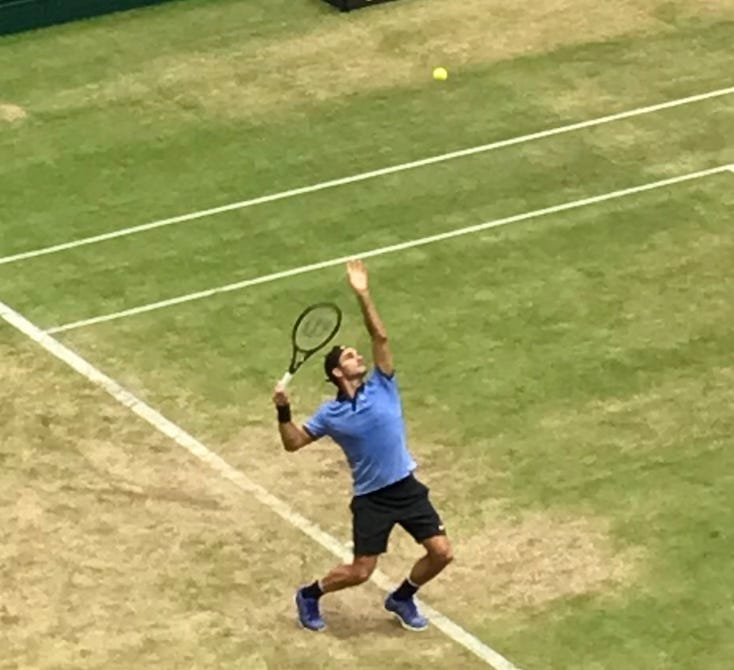
Federer serving at Halle, 2017 — the only time I saw him play in person.
Who is the tennis GOAT?
These days, most people point to Novak Djokovic. He’s won 24 major titles, capturing all four Grand Slams multiple times, and holds winning records over his two main rivals. Rafael Nadal, with 22 majors, is often mentioned too—but his dominance has been largely on clay. He’s the undisputed king of Roland Garros, but that specialization also puts him in a separate category.
That leaves Federer at a distant third, with only 20 major titles. And yet—he’s my GOAT.
Why would someone with fewer titles even be in the running? That question gets to the heart of how we define greatness. Every athlete competes in a particular era, shaped by circumstances unique to that time. Federer arrived before both Nadal and Djokovic, and had to endure—then adapt—as the game changed dramatically around him.
There’s also Rod Laver, often cited as the original GOAT, having won all four majors in the same year—not once, but twice. No one has accomplished a calendar Grand Slam since. Federer and Djokovic came close but fell just short.
So rather than take a strictly statistical approach—tallying up the accomplishments of each player—I want to offer another way of thinking. I borrow this from Albert-László Barabási’s The Formula, where he lays out several principles for understanding success.
My favorite:
Performance is bounded. Success is unbounded.
This, to me, is Federer in a nutshell.
His performance—yes, extraordinary—has its limits. He didn’t win the most. But his success? That flowed far beyond the court. He became something more. He arrived at the intersection of two centuries, two styles, two philosophies of play. He mastered the old game—serve and volley, one-handed backhands, closing in at the net—and then retooled his approach to thrive in the new baseline era. He played offense and defense with equal precision. His style was graceful, powerful, and mythic. He floated like a dancer just above the surface.
His influence moved beyond tennis. He became an ambassador, an icon, a brand, a foundation. He inspired a generation of players, artists, thinkers, and fans. His success was—and remains—unbounded. And I believe that, long after the records are forgotten, he will be remembered more than either Nadal or Djokovic.
Most of us will never have the kind of success that these great athletes had in their domain. But there’s a lesson here. Since our performance is bounded—we can only do so much in a day—we might ask: What endures? What do we create that extends beyond the immediate task?
To me, the story of Federer—through the lens of Barabási—reminds us that doing more with less can be a powerful strategy. Style, grace, timing, reinvention—these are harder to quantify, but they last.
In that sense, we can all strive to be our own GOATs. Not by outscoring everyone, but by becoming the best version of ourselves—doing work that carries meaning, and maybe even leaves a mark beyond our own timeline.
Federer has a special place in your heart ❤️ I’ve never cared much about tennis, but I loved the documentary about his final days. I’m drawn to how top performers think.