
My Dinner with Anders
How the birth of my new was marked by a single meeting with one of my academic heroes four years ago

I was flying to Tallahassee on December 18, 2019, for a meeting and was 5 minutes from running out the plane’s WIFI when a thought crossed my mind. What if I write Anders and let him know I will be in town?
The 10,000-Hour Man
Anders was K. Anders Ericsson. His work was an inspiration for the book Outliers in which Malcolm Gladwell had coined the term the “10,000-hour rule.” Ericsson had dedicated his entire career to understanding what distinguished experts from non-experts. His studies had involved experts across a wide range of fields, including music, chess, and sports. What he found, was that expertise in a skill was related to the number of hours of practice. His findings showing that more hours of focused practice which he called deliberate practice was key. His findings on deliberate practice and Gladwell’s 10,000-hour rule had become so engrained in the popular culture at the time that it led some to test it directly. One example of this was Dan McLaughlin, who decided to pursue 10,000 hours of golf practice to see if he could become a pro. Mclaughlin called his own version of this “The Dan Plan.”
Ericsson’s work was also featured in my first book, The Bilingual Brain. In two separate chapters, I had considered the nature of expertise both within and outside of language. Because I wanted to find analogies between expertise in language and expertise in general, I had spent a great deal of time reading Ericsson’s work. I had written him emails to express my admiration to which he had responded. But I had never met him in person. Since I would be in Tallahassee, I thought I might have a chance.
The Invitation
I wrote him a short email, apologizing for writing so last minute, but asking nicely if we could at least have a cup of coffee. I said I was free that very evening but could meet him anytime that would work for him in the next few days. When I landed, I anxiously opened my laptop up again and saw that Anders had already responded! He would be happy to meet me at Shula’s at 6 pm. I boarded a second plane and when I landed, Anders had written again. He checked the flights and saw that 6 pm was way too early. He tried to switch to 6:30 pm but could only get 6:45. That such a giant in the field could be so accommodating to a total stranger was a breath of fresh air.
As I entered Shula’s, I recognized him immediately and introduced myself. As we exchanged a few pleasantries, the waiter approached us and asked, “How are you this evening?” We both responded, “Very well, thank you.” “Are you celebrating any special occasion,” he asked. “A birthday, a reunion,” he continued. Anders sat quietly. The importance of the occasion was not lost on me and somewhat spontaneously I blurted out “Not a birthday or a regular special occasion. But I am getting to have dinner with one of my academic heroes,” I said. Anders was surprised at my candor, and I could see him a bit shocked that I would say it out loud so clearly. He quietly signaled that he was very happy to be there as well.
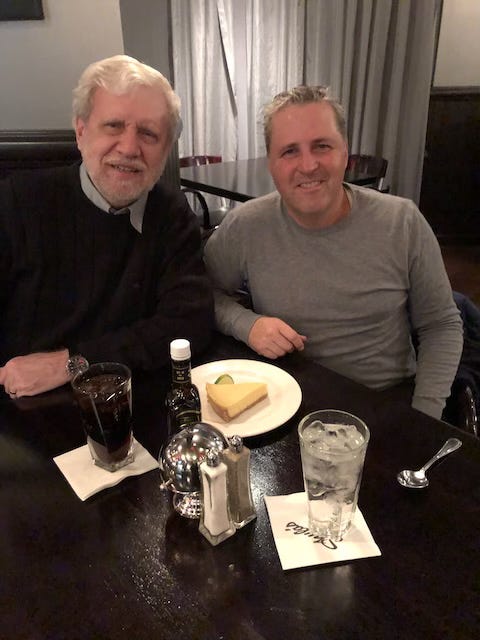
The evening felt like a throwback to my days in graduate school. Anders and Liz Bates, my doctoral advisor, had been at CU Boulder around the same time. They both knew Walter Kintsch and other colleagues I had heard Liz tell me about. It gave me a connection to the past in a way that I had lost when Liz passed away in 2003. As our discussion continued, I remember thinking that how rare it was to run across a scholar these days. Ericsson was genuinely interested in my work and in learning about what I did. His responses made me think that I could ask him not just about science but also about his approach to science.
Q&A with Anders
What do you think about the fact that publication rates are accelerating, and that people are in a rush to publish more and at a faster rate?
He recounted how the chair of his department at CU wanted him to break a publication up into parts so that he could have more of them. He also wanted him to publish in certain journals. He refused to do so and left CU Boulder. He elegantly showed his disapproval of publishing more. Science was about asking questions. The publications were a result of that not the end in itself. He clearly noted that the good work in whatever field was unusual and thus it could not be mass produced or result in greater quantity. It was a breath of fresh air to see that prominence in a field could be attained with intense focus on a question and the process of understanding the answer to that question. He did not even mention his book, Peak.
What about the academic hierarchy? How do you feel that certain schools are the ones that dominate the academic market?
Lots of schools give out Ph.D.’s. Florida State University and the University of Houston are well known schools that are competitive in attracting very good students. But they are not at the top of the hierarchy. Schools at the top are part of “Ivy+ institutions”, a handful of private and public universities who place their Ph.D. graduates into other high-ranking institutions. It is like a Royal family. A Ph.D. from an Ivy+ institution puts a candidate into a prominent position that aids in gaining entrance into one of the “family” member’s homes. “Commoners” from lesser means rarely gain entrance.
Anders noted that his students had been able to find academic jobs. They had been productive and so did not see the need to be at the very best institution. But none of them had been incredibly prolific. They had published 3-4 papers in very good journals. He even noted that it was not necessary for students to have solely first-authored papers. I pressed him a little bit. After all, all of the papers his students published had Ericsson’s name on them. This is customary practice in the field. It might be the case that a person as well-known as him could add extra weight for a student. Of course, he acknowledged the fact that he knew a great number of prominent people in the field and that this social capital likely had some impact on his students’ success in the academic marketplace. To him being at Florida State University rather than being at a more prestigious institution had no bearing on his success.
What do you think of people who suggest that you are not taking into account how individuals reach expert ability at different rates?
One of the interesting things about speaking with Ericsson was how faint his accent in English was. In fact, Ericsson differed tremendously from one of my tennis heroes, Bjorn Borg, who had a very strong Swedish accent in English. Work in the field, had found that some non-native speakers had an imperceptible accent whereas others did not. Ericsson was in the former group and Borg clearly was not. Borg has spoken English for quite some time and yet retained his accent. We could compare him to Novak Djokovic and Roger Federer who have very light accents in the multiple languages they speak. Some people simply have a better “ear” and “mouth” for language. In the skill learning literature, similar types of differences had emerged. Some experts actually need to train less than those who are bit below them. This made me wonder if some people have more “potential” in any particular field. In other words, maybe practice can only take a particular person so far.
His answer to my question gave me an insight that I had never gained in his writings. Anders focus on the role of practice was the product of his focus on data quality. When he started his career, he spent some time looking for really good data that followed people across time. It just happened to be that music practice was a well-documented set of data and thus he could establish a link between practice and expertise. His view of the data was much less flashy than that I had read in books like Outliers. He was simply trying to establish a relationship between the practice and expertise using the best data he had at the time. Again, I was intrigued by his focus on good science and data.
I was also really pleased to be able to go back and forth with him. Rather than take my question as an afront to his view, Anders asked me a lot of follow up questions. He was clearly puzzled by the way I was framing my questions. Anders still wanted to learn, and he treated this opportunity as a chance to gain more knowledge. I wasn’t just meeting him; it was clear that Anders was meeting me too.
The first and last meeting with Anders Ericsson
We wrapped up with dessert, one of the best slices of key lime pie, split the check and I walked with him to wait for the valet. He offered me a ride and we parked for a few minutes in front of my hotel. I thanked him for having met with me and he was equally gracious. He then said that if I ever needed anything to contact him. In that moment, I imagined spending a sabbatical soaking in all the work in his lab and interacting with him and his students. I said goodbye, closed the door, waved goodbye one last time, and then watched as he drove off.
Feeling inspired, I awoke the next day to crystal blue skies. But there were so many questions that I still wanted to ask.
A few days before we met, a phrase, The Emergence of Skill, had popped into my head. In my own view, practice was just a small part of it. Skills were not just made they also bloomed like a flower that takes water, soil and air temperature into account when growing. It is the product of multiple small forces that coalesce into a greater whole.
Unfortunately, Anders would pass away just a few months later in early 2020. Although Anders and I never got a chance to speak again, many of the themes we touched on that evening became the topic of a new book that I went on to write after our meeting. Today, I await the publication of my new book entitled Mastery: How Learning Transforms our Brains, Minds and Bodies due out on April 16, 2024, from Prometheus books. Only now do I realize how lucky I was to have met him on that December day four years ago.