
How I Got My Class Back
Rethinking Cognitive Psychology in an Age of Information Overload

A year ago, I found myself asking a difficult question: What is happening in my classes? I had just read my teaching evaluations for Cognitive Psychology, and they were hard to absorb. Many students felt lost, unsupported, and confused—not just by the material, but by how the course was structured and how I was teaching it. They described the lectures as disorganized, the assignments as unclear, and the stories as distractions. “We had to teach ourselves,” one student wrote. Another said, “Nothing about this class was organized.” A third asked, “Is this really the state of our psychology department?”
I couldn’t ignore what they were saying. And for the first time in years, I didn’t recognize my own classroom.
But I hadn’t yet seen the full picture. A conversation with my colleague Ferenc Bunta helped me see what I had missed. He listened, then said something that stayed with me: “You’re still teaching a class designed entirely from the textbook. That might have worked in 2010. That class is not YOUR class.” And he was right.
In those earlier years, students came to class without being asked, without points or penalties. They came because they wanted to be there, because there was something irreplaceable about showing up. Being in the room mattered. There was a shared understanding that the classroom mattered. But after COVID, that rhythm broke. Students had adapted to learning on their own terms. At first, I saw this as disengagement. But that was too simplistic. Something deeper had shifted.
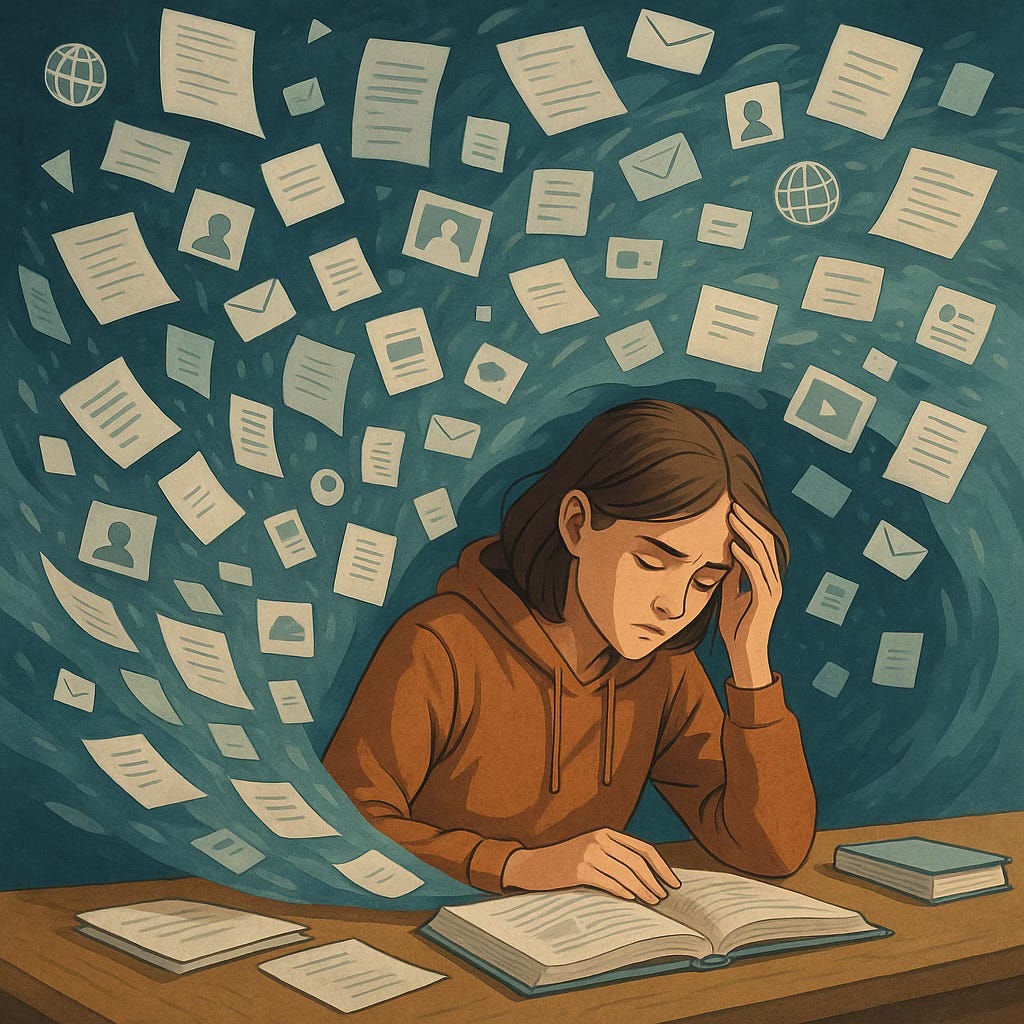
A student overwhelmed by a flood of digital and analog information—a visual metaphor for the modern cognitive classroom
Source: Illustration by DALL·E / OpenAI
Socially rich, informationally poor. That’s the world I used to teach in. In the early 2000s, students came to class because professors were still the primary source of knowledge. But the world has changed completely. In his 2014 book The Revolt of the Public, former CIA analyst Martin Gurri observed that by the early 2000s, the volume of information being produced was doubling every year. Most people didn’t notice. Gurri did. And he understood something I hadn’t yet grasped: that this flood of information would erode traditional authority—including in education.
Today’s students are informationally rich but connection-starved. They’re drowning in content, unsure what matters and what doesn’t. The question is no longer where to find information—it’s how to make sense of it. And I was still speaking into a room shaped by a past that no longer existed. I was giving them too much—too fast, too loosely. What they needed wasn’t more information. It was orientation.
Oddly, the second piece that helped clarify things came not from pedagogy but from publicity training. When my book Mastery came out, I hired a firm to promote my book. One of the key lessons I learned was how to answer questions during interviews. They trained me to speak in sound bites—concise, intentional, memorable. At first it felt unnatural. But midway through the training, I realized: this is what my students need too. I had been overwhelming them. They didn’t need more content. They needed clarity.
So I changed. I taught in sound bites—focused, grounded, deliberate. I slowed down. I gave students space to reflect. I used low-stakes quizzes to reinforce key ideas. I told fewer stories, and only when they served a clear purpose. My goal wasn’t to fill the hour. It was to earn their trust.
This spring, the feedback reflected that shift. Students wrote, “He encourages us to think about each chapter and gives us small quizzes to help us understand the material.” Another said, “The professor really allowed us to think outside of the box… This helped me understand each chapter and gave me a better grasp over cognitive psychology.” One noted, “The professor is very engaging and provokes us to think about how our cognition works.”
What changed wasn’t just my teaching. It was my understanding of what students need. In a world flooded with information, clarity is connection. Slowing down helped them feel more grounded. And that grounding—rooted in presence and intention—made learning possible.
Next year, I plan to take this further. I’m considering redesigning the course around autobiographical memory—using each student’s lived experience as a foundation for understanding the mind. Rather than teaching cognitive psychology as a schematic of our mental machinery, I want to teach it as something that emanates from within: from their attention, their language, their perception, their problem-solving, their memory. Each chapter will invite reflection—linking science to personal experience. My hope is that by grounding the material in their own stories, students will understand the concepts more deeply and feel more connected to them. Cognitive psychology, in this model, becomes not just the study of systems, but of selves. Not just how the mind works—but how it feels to have a mind at all.