
Why I Still Love Academia

I ask students to write their reflections by hand. In our digital age, when they start writing I have to stop them because they will keep writing and writing and writing for minutes at a time. Simple questions, like tell me about what you did in the last twenty minutes. I warn them we do not have twenty minutes for this, try to keep it succinct. I look out at the room and see students off of their devices. Laptops may be open, phones may be visible next to them, but they are engrossed in their writing. All heads are down, hands moving across the page. The whole class moves like a set of coordinated movements, a silent writing symphony. And then I begin to ask questions about their reflections so they can reflect back to me. We are talking about episodic memory and how it works, and what I am watching is episodic memory being produced in real time. Students are not just learning about the mechanism. They are demonstrating it, right there on Monday morning, without meaning to. When I ask them to stop so we can talk about how all of this works, many continue writing even though they do not have to anymore. They cannot help it. That is the point.
I have taught cognitive psychology for close to twenty years. I know my textbook inside out, know it well enough to walk into any lecture cold and start almost cold. You would think that by now I would be bored of it. The truth is every semester is different. Every time I encounter the same material it changes me and I change it.
A few years ago, I read my teaching evaluations and they were brutal. Nothing about this class was organized. We had to teach ourselves. Is this really the state of our psychology department. My first instinct was defensive. These students want to be spoon-fed. They do not understand how real learning works. But I kept reading and I could not shake the feeling that they were right. My colleague Ferenc Bunta said it plainly: you are still teaching a class designed entirely from the textbook. That might have worked in 2010. But that class is not your class. He was right. I had to ask myself, for the first time in a long time, whether I still knew what I was doing here.
Every semester I ask my class whether anyone is reading a book that is not assigned to a course, a book they are reading because they want to. They ask back, do you mean a book we are reading for fun? And I say yes, for fun. The hands go up. It used to be only a few but now, increasingly, every semester it is sometimes half the class. When I ask whether anyone has that book with them, three or four will pull it out of their bag. Someone else will say: I do not have it with me because it is too thick, I cannot carry it around, but I read it every night. I have it at home on my nightstand.
That student stays with me. Because that student is exactly what my grandfathers were working toward. Not a degree. Not a credential. A person who reads because they cannot help it. A person who carries a book that is too heavy but carries it anyway. That is what education does when it works. That is what it was always supposed to do.
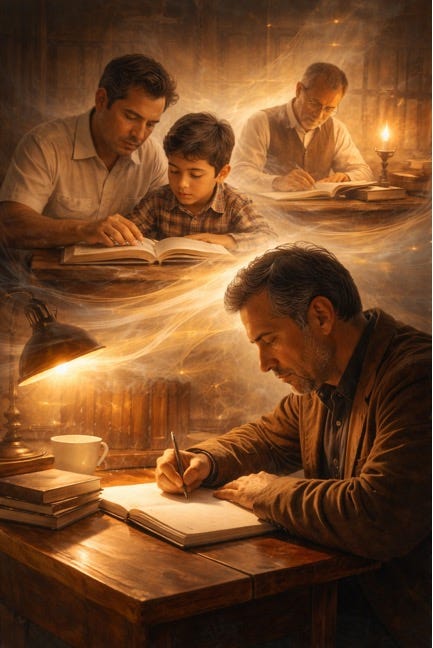
My paternal grandfather, Luciano Hernández Cabrera, was the son of a farmworker. His father arranged for the family to move into town so that Luciano could go to school. That single act changed everything. He became a teacher, then a school director, then traveled to Korea to help rebuild its national education system after the second world war, and ended his career as personal secretary to the governor of San Luis Potosí. He also knew that every language you learn is another world you can enter, another set of eyes you can borrow. He arranged for my three aunts to travel by train to Kentucky and spend a year there as adolescents, learning English young, before the world would demand it of them.
My maternal grandfather, Miguel Ángel Corpi Aguirre, worked for the telegraph service, coordinating repairs along the lines so that information could keep moving across Mexico. He made sure that everyone in his family went to school and studied as much as they could. Almost all of them went to college. Neither of my grandfathers had attended a university themselves. Both of them made sure their children would.
As much as the university wants to become a place of skills, of jobs, of training, it is in its core a place of thinking, of writing, of discussing, of learning. My grandfathers knew this before I did. They knew it without having set foot inside one.
My great-grandfather moved his family into town so his son could go to school. That son went to Korea. His son became a professor. His grandson also became a professor. His great-grandchildren are out there right now, staying up late reading books no one assigned them.
The chain holds.